
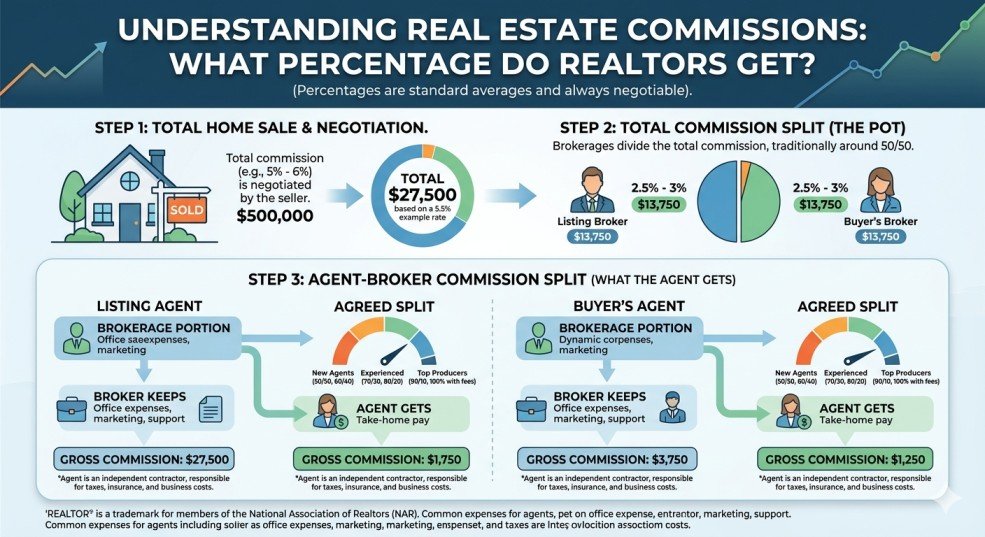
If you’re selling or buying a home, one of the first questions you probably ask is: what percentage do realtors get? It’s a fair question. Real estate commissions are often the single biggest closing cost, and understanding them can save you thousands of dollars.
The short answer is that the national average real estate commission in 2026 is 5.70% of the home’s sale price. This is typically split between the listing agent (who represents the seller) at 2.88% and the buyer’s agent at 2.82% .
On a median-priced U.S. home of around $368,000**, that works out to roughly **$21,000 in total agent fees .
But that number is just the starting point. The real story is more complex. Commissions vary by state, they’re fully negotiable, and recent rule changes have shifted how they work. This guide breaks down everything you need to know.
Quick Answer: What Percentage Do Realtors Get?
The national average real estate commission in 2026 is 5.70% of the home’s sale price. This is typically split between the listing agent (representing the seller) at 2.88% and the buyer’s agent at 2.82% . On a median-priced U.S. home of approximately $368,000, this translates to roughly $21,000 in total agent fees . Rates vary by state, ranging from 4.50% in Washington D.C. to 6.20% in Michigan .
Key Takeaways:
- National average: 5.70% (2026 data)
- Listing agent receives: 2.88% on average
- Buyer’s agent receives: 2.82% on average
- Total commission on $368,000 home: ~**$21,000**
- Commissions are fully negotiable — no fixed rates
How Real Estate Commission Works: The Breakdown
The Traditional Split Structure (Pre-2024)
For decades, the real estate commission system worked like this:
- The seller paid the full commission (typically 5% to 6%)
- The total was split roughly 50/50 between the listing agent and the buyer’s agent
- Each agent then split their share with their brokerage
This system was convenient but also meant that sellers bore the entire cost of both agents. Many buyers had no idea that their agent’s fee was coming out of the seller’s pocket.
What Changed: The 2024 NAR Settlement
In August 2024, a landmark settlement involving the National Association of Realtors (NAR) changed how commissions work .
Key changes effective August 17, 2024 :
- Offers of compensation will be prohibited on Multiple Listing Services (MLSs). Offers of compensation will continue to be an option consumers can pursue off-MLS through negotiation and consultation with real estate professionals .
- Agents working with a buyer must enter into a written buyer agreement before touring a home. The practice changes do not require an agency agreement or dictate any type of relationship .
- Sellers can still offer concessions like closing cost assistance on the MLS. However, blanket offers of cooperating compensation from one broker to another will not be allowed in any field on the MLS .
- The settlement releases liability for most Realtor members from lawsuits related to seller-paid commissions .
What this means for you:
- Sellers: You pay your listing agent (typically 2.5% to 3%). You can choose whether to offer buyer’s agent compensation as a concession to attract more buyers.
- Buyers: You now negotiate your agent’s fee directly. However, many sellers still offer to pay this fee to make their property more attractive to buyers. Off-MLS offers of compensation help make homeownership more accessible to buyers—especially first-time homebuyers .
Despite these changes, commissions in 2026 have actually increased slightly to 5.70% from 5.44% in 2025, reaching a five-year high .
Real Estate Commission Examples by Home Price
To really understand what these percentages mean, let’s look at real dollar amounts. Here’s what a traditional 6% commission looks like across different home prices:
| Home Price | Total Commission (6%) | Listing Agent (3%) | Buyer’s Agent (3%) |
| $200,000 | $12,000 | $6,000 | $6,000 |
| $300,000 | $18,000 | $9,000 | $9,000 |
| $400,000 | $24,000 | $12,000 | $12,000 |
| $500,000 | $30,000 | $15,000 | $15,000 |
| $750,000 | $45,000 | $22,500 | $22,500 |
| $1,000,000 | $60,000 | $30,000 | $30,000 |
And here’s what the 2026 national average of 5.70% looks like :
| Home Price | Total Commission (5.70%) | Per Agent (50/50 Split) |
| $200,000 | $11,400 | $5,700 |
| $350,000 | $19,950 | $9,975 |
| $500,000 | $28,500 | $14,250 |
| $750,000 | $42,750 | $21,375 |
| $1,000,000 | $57,000 | $28,500 |
Average Real Estate Commissions by State (2026)
Commission rates vary significantly depending on where you live. States with higher home values tend to have lower percentage rates because the dollar amount is already substantial .
| State | Rate | State | Rate | State | Rate |
| Alabama | 5.96% | Kentucky | 5.66% | North Dakota | 5.84% |
| Alaska | 5.51% | Louisiana | 5.66% | Ohio | 5.90% |
| Arizona | 5.82% | Maine | 5.57% | Oklahoma | 5.82% |
| Arkansas | 5.66% | Maryland | 5.41% | Oregon | 5.51% |
| California | 5.47% | Massachusetts | 5.57% | Pennsylvania | 5.77% |
| Colorado | 5.71% | Michigan | 6.20% | Rhode Island | 5.57% |
| Connecticut | 5.57% | Minnesota | 5.84% | South Carolina | 5.88% |
| Delaware | 5.66% | Mississippi | 5.66% | South Dakota | 5.84% |
| DC | 4.50% | Missouri | 5.94% | Tennessee | 6.05% |
| Florida | 5.57% | Montana | 5.71% | Texas | 5.88% |
| Georgia | 5.66% | Nebraska | 5.84% | Utah | 5.71% |
| Hawaii | 5.51% | Nevada | 5.71% | Vermont | 5.57% |
| Idaho | 5.71% | New Hampshire | 5.57% | Virginia | 5.50% |
| Illinois | 5.53% | New Jersey | 5.20% | Washington | 5.90% |
| Indiana | 5.50% | New Mexico | 5.82% | West Virginia | 5.66% |
| Iowa | 5.84% | New York | 5.69% | Wisconsin | 5.84% |
| Kansas | 5.84% | North Carolina | 5.53% | Wyoming | 5.71% |
**Source: Clever Real Estate’s 2026 agent survey **
Regional summary:
- Midwest: Highest average at 5.83% (Michigan leads at 6.20%)
- Southwest: 5.84% (Texas at 5.88%)
- Southeast: 5.60% (Tennessee at 6.05%)
- Northeast: 5.56% (New Jersey lowest among states at 5.20%)
- Pacific: 5.65% (California at 5.47%)
- Rocky Mountains: 5.65%
What Percentage of Commission Do Realtors Actually Take Home?
This is where things get interesting. When you pay a 5.70% commission, the agent doesn’t keep all of that money.
The Broker Split
Real estate agents typically work under a brokerage, and they must split their commission with their broker. Common splits include 50/50, 60/40, or 70/30 (agent/broker).
For example, at eXp Realty, agents split their earned commission with the brokerage at an 80/20 percentage after reaching the commission split cap of $16,000 per anniversary year .
Example on a $300,000 home with a 6% commission:
- Total commission: $18,000
- Listing agent’s share (3%): $9,000
- Broker’s cut (20%): $1,800
- Agent’s take-home before expenses: $7,200
Agent Expenses
Before an agent sees any money, they also have significant expenses including:
- Vehicle costs
- Marketing and advertising
- Association fees
- Professional photography
- Insurance and taxes
After all expenses are accounted for, the average realtor typically takes home a much smaller portion of the commission.
Can You Negotiate Real Estate Commission?
Yes. Commissions are fully negotiable. There is no legally fixed rate. Real estate agents are independent contractors who can set their own rates, meaning there is room for discussion .
When You Have Leverage
You have the most negotiating power when:
- High-value properties: Agents may accept a lower percentage because the dollar amount is still substantial.
- Hot seller’s markets: When homes sell quickly, agents are more willing to compete for your listing.
- You already have a buyer: If you have a “pocket buyer” (friend, family, or neighbor), the agent doesn’t need to market the property.
- Repeat business or referrals: Agents value ongoing relationships.
- You’re buying another home with the same agent: Dual transactions are attractive to agents.
Negotiation Tips
Tip 1: Timing is crucial. The best opportunities arise during your initial meeting with an agent or before signing a listing agreement .
Tip 2: Shop around. Don’t settle on the first agent you meet. Compare different agents and their commission structures .
Tip 3: Be direct and respectful. When asking for a lower commission, be direct but maintain a respectful tone. A polite, professional request is more likely to be received positively .
Tip 4: Highlight your property’s value. If your property is in excellent condition or located in a desirable area, use this as leverage .
Key fact: Recent surveys reveal that nearly two-thirds of those who asked for a reduction in commission fees were successful. This statistic underscores the power of simply asking .
Negotiation Scripts
Script 1 (Research-based):
“I’ve researched average commission rates in our area, and they range from X to Y. Based on your experience and services, what’s the most competitive rate you can offer me?”
Script 2 (Competitive):
“I’m deciding between several agents. If we work together, can you reduce your listing commission to 2%? My home is in great condition and I’m prepared to move quickly.”
Script 3 (High-value home):
“Given this home is valued at $[X], a lower percentage still represents a significant commission. Could we work with a rate of 2.5% instead of 3%?”
Why You Might Still Pay the Full Commission: The Steering Effect
If commissions are negotiable, why do most people still pay the traditional rate?
The answer is steering.
Research from Texas McCombs found that houses with the lowest commissions were 51% less likely to sell at all than those with commissions at the going rate. Properties that offer lower commissions to buyer agents take a third longer to sell and are more likely to go unsold.
Why this happens:
- Buyer’s agents may avoid showing properties with low commissions
- Agents have a financial incentive to show homes where they’ll earn more
- Even with the NAR settlement, this dynamic still exists
This explains why commissions in the U.S. (5-6%) remain higher than in countries like the UK (1.5-2%).
Frequently Asked Questions
What percentage do most realtors charge?
Most real estate agents charge between 5% and 6% of the home’s sale price. In 2026, the national average is 5.70%, split between the listing agent (2.88%) and buyer’s agent (2.82%) .
Who pays realtor fees—buyer or seller?
Traditionally, the seller pays the full commission. Under the 2024 NAR rule changes, sellers pay their listing agent directly, while buyers negotiate their agent’s fee separately. However, sellers can still offer to cover the buyer’s agent fee as a concession .
How much do realtors make on a $100,000 house?
At the 2026 national average of 5.70%, the total commission on a $100,000 home is $5,700. Split evenly, each agent would receive $2,850 .
How much do realtors make on a $300,000 house?
At the 2026 national average of 5.70%, the total commission on a $300,000 home is $17,100. Split evenly, each agent would receive $8,550 .
How much do realtors make on a $500,000 house?
At the 2026 national average of 5.70%, the total commission on a $500,000 home is $28,500. Split evenly, each agent would receive $14,250 .
Are real estate commissions negotiable?
Yes, commissions are fully negotiable. There is no legally fixed rate. Nearly two-thirds of those who ask for a reduction are successful .
Conclusion
Understanding what percentage realtors get is essential for any home buyer or seller. In 2026, the national average is 5.70%, but rates vary by state and are fully negotiable .