
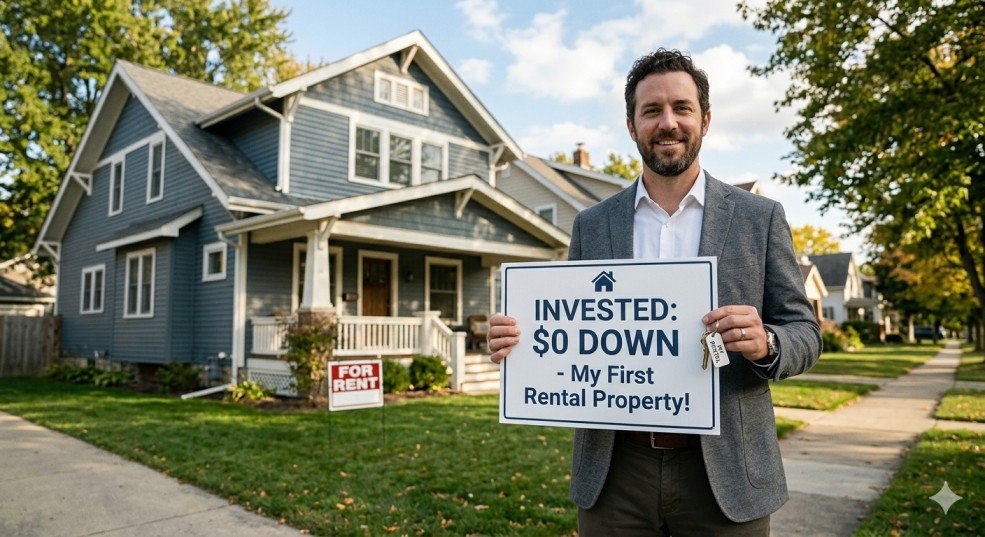
You have read the books, watched the YouTube videos, and listened to the podcasts. You know real estate builds wealth. But every time you look at the numbers, you hit the same wall: you don’t have $40,000 to $60,000 sitting in the bank for a down payment.
Here is what they don’t tell you: You don’t actually need the cash.
Thousands of investors have bought rental properties with zero money down. The strategies exist. They are legal. And they work. The question is not if you can do it—it is which strategy fits your situation.
This guide covers seven proven strategies to buy rental property with no money down. You will learn the exact credit score requirements, the risks to watch for, and how to choose the right path for your situation.
By the end, you will have a clear, actionable roadmap to buy your first rental property—even if you have no savings.
Can You Really Buy a Rental Property With No Money Down?
Yes, it is legal, and it has been done by thousands of investors.
The concept of buying real estate with nothing down has been around for decades. The key is understanding what “no money down” actually means.
What No Money Down Really Means
No money down does not mean “free money.” It means you are using Other People’s Money (OPM), creative financing structures, or government-backed programs to eliminate the need for your own cash at closing.
What it DOES mean:
- Using home equity from a property you already own
- Negotiating seller financing
- Partnering with someone who has capital
- Using government loans that require zero down payment
- Structuring creative deals where the seller carries the financing
What it DOES NOT mean:
- Getting a property for free with no financial obligation
- A magic trick that avoids all risk
- A strategy that works without any preparation
No Money Down vs. Low Money Down
Some strategies (VA loans, seller financing) can truly be 0% down. Others, like FHA loans, require a small down payment of 3.5%—which on a $300,000 property is $10,500. For most investors, this falls close enough to “zero” to make a meaningful difference.
Strategy #1: House Hacking (The Beginner’s Best Option)
House hacking is the most accessible strategy for first-time investors. You buy a multi-unit property—duplex, triplex, or fourplex—live in one unit, and rent out the others to cover your mortgage.
Why it is considered the safest path: You are living in the property, so you can manage it directly. The rental income from the other units offsets your housing costs. Many house hackers live for free while building equity.
How It Works With No Money Down
FHA Loan (3.5% down): You can buy a 2-to-4 unit property with as little as 3.5% down if you live in one of the units.
VA Loan (0% down): If you are a veteran or active-duty service member, you can buy a multi-unit property with zero down payment.
FHA Loan Requirements
The Federal Housing Administration backs these loans, which allows lenders to accept lower credit scores and smaller down payments.
FHA Requirements:
- Minimum down payment: 3.5% with a credit score of 580 or higher
- Credit score 500-579: May still qualify with a 10% down payment
- Property types: 1-to-4 unit properties (you must live in one)
- Standard loan limit: $541,287 in most areas for single-unit properties
- Two-unit properties: $693,050
- Three-unit properties: $837,700
- Four-unit properties: $1,041,125
- High-cost areas: Up to $1,249,125 for single-unit properties
VA Loan Requirements
VA loans are the most powerful zero-down tool available—but only for those who qualify through military service.
VA Requirements:
- Down payment: 0%
- No Private Mortgage Insurance (PMI)
- Property types: Up to 4 units, as long as you live in one
- Move-in requirement: Within 60 days of closing
- Occupancy period: At least 12 months as your primary residence
VA Funding Fee Rates (effective April 7, 2023):
| Loan Use | Down Payment | Funding Fee |
| First use | Less than 5% | 2.15% |
| First use | 5% or more | 1.5% |
| First use | 10% or more | 1.25% |
| Subsequent use | Less than 5% | 3.3% |
| Subsequent use | 5% or more | 1.5% |
| Subsequent use | 10% or more | 1.25% |
Who is exempt from the VA funding fee:
- Veterans receiving VA compensation for a service-connected disability
- Veterans eligible for VA compensation but receiving retirement or active-duty pay instead
- Surviving spouses receiving Dependency and Indemnity Compensation
- Active-duty members who received a Purple Heart
House Hacking Math Example
Duplex Purchase:
- Purchase price: $420,000
- VA loan down payment: $0
- Monthly mortgage (PITI): $2,850
- Rent from the other unit: -$1,600
- Your effective housing cost: $1,250
Instead of covering the full mortgage alone, rental income offsets a large portion of your payment.
Strategy #2: Seller Financing (Vendor-Take-Back Mortgage)
Seller financing cuts out the bank entirely. Instead of getting a mortgage from a traditional lender, you make payments directly to the seller. The seller acts as the lender.
How Seller Financing Works
The seller sets the down payment requirement—sometimes as low as 0%. You agree on the terms: interest rate, loan term, monthly payments, and whether there is a balloon payment at the end.
Structure types:
- Full seller financing: The seller provides the entire loan amount
- Junior mortgage/Seller second: The seller provides a second mortgage to cover the gap between a traditional bank loan and the full purchase price
- Rent-to-own/Lease option: You rent with a contract to buy at a set price within a defined timeframe
Seller Financing Example
- Property price: $200,000
- Traditional bank loan: $150,000
- Seller carries a second mortgage: $50,000 at an agreed interest rate
- Your down payment: $0 (the seller agrees to no down payment)
You are now the owner with zero cash out of pocket.
Where to Find Seller Financing Deals
- “For Sale by Owner” (FSBO) properties
- Motivated sellers (divorce, foreclosure, relocation, inherited property)
- Real estate agents who specialize in creative financing
- Local real estate investor groups
Seller Financing Risks
- Interest rates can be higher than traditional mortgages
- Short loan terms (often 3-5 years) may create a balloon payment
- Fewer buyer protections than regulated bank mortgages
- You must find a willing seller
Always work with a real estate attorney when structuring seller financing.
Strategy #3: VA Loan (0% Down for Veterans)
If you qualify for a VA loan, this is the single most powerful tool available for zero-down rental property financing.
The Occupancy Rule
You cannot use a VA loan to buy a pure investment property. However, you can legally rent out extra units in a multi-unit property while you live there.
The requirement: You must move in within 60 days and live there for at least 12 months. These are non-negotiable compliance standards. If you don’t follow them, you are committing fraud and could lose your VA loan benefits.
After 12 Months: Your Flexibility
After meeting the minimum occupancy requirement, you can:
- Turn the property into a pure rental
- Rent out all units
- Buy another VA loan property (depending on entitlement availability)
VA Loan Program Growth
In fiscal year 2025, the VA loan program made over 500,000 loans. VA loans made up a significant percentage of all purchase loans for owner-occupied homes.
Strategy #4: USDA Loan (0% Down for Rural Properties)
USDA loans offer 100% financing with no down payment on properties in USDA-designated rural and suburban areas.
The strategy: Some of the strongest rental markets sit inside USDA-eligible zones—lakeside towns, coastal communities, and rural retreats near national parks.
Requirements:
- Property must be in a USDA-eligible area
- Primary occupancy required (house hacking rules apply)
- Income limits apply
Like VA loans, USDA requires primary occupancy—but you can still rent out other units if you live in one.
Note: USDA Farm Service Agency loans are primarily for agricultural operations. For residential USDA Rural Development loans, check the USDA Rural Development website for program details.
Strategy #5: BRRRR Method (Buy, Rehab, Rent, Refinance, Repeat)
BRRRR is the capital recycling engine behind most portfolio-scale rental investors. The strategy works because you manufacture equity through renovation rather than waiting for the market to deliver it.
How BRRRR Works
| Step | Action |
| Buy | Purchase a distressed property at a steep discount—ideally 25-30% below after-repair value |
| Rehab | Renovate the property to force equity |
| Rent | Place a tenant to generate cash flow |
| Refinance | Refinance based on the new, higher value (After Repair Value or ARV) |
| Repeat | Pull your capital back out and do it again |
The 70% Rule
Purchase price plus rehab costs must stay below 70% of the After Repair Value (ARV). This ensures your refinance math works.
BRRRR Example
- Purchase: $90,000 (funded with a hard money loan)
- Rehab: $30,000
- ARV after rehab: $200,000
- Refinance at 75% of ARV: $150,000 pulled out
- Total invested: $120,000 ($90k purchase + $30k rehab)
- You get back: $150,000 at refinance
- Result: You have a $200,000 property with $50,000 in equity—and you got your original capital back
Funding BRRRR
Hard money loans are essential for the Buy and Rehab phases because you need speed. Traditional banks take 30-45 days for approval. Hard money lenders can close in 3-5 days.
Hard money terms (2026):
- Interest rates: 8.5% to 11% (some lenders charge 12% or more)
- Points/Origination fees: 1-3 points (1 point = 1% of loan amount)
- Terms: 6-24 months
- Closing time: 3-5 days
- Approval: 24-48 hours
- Loan-to-value: Typically up to 65% of property value or after-repair value
Hard money carrying costs add up fast. At 12% interest, holding $130,000 for 6 months costs $7,800 in interest alone.
Strategy #6: HELOC and Cash-Out Refinance (Using Home Equity)
If you already own a home, you likely have equity you can use. A HELOC or cash-out refinance lets you pull equity out and use it as a down payment on a new investment property.
From the perspective of the new deal, you have bought a property with no money down out of pocket. You are using your home’s equity instead of liquid cash.
HELOC vs. Cash-Out Refinance
| Feature | HELOC | Cash-Out Refinance |
| What it is | A line of credit against your home equity | A new, larger mortgage that replaces your existing one |
| How you get money | Draw what you need as you go | Lump sum at closing |
| Interest rate | Variable typically | Fixed typically |
| Closing costs | Lower | Higher |
The Risk
You are securing a new debt against your primary residence. If your rental property underperforms, you still owe the HELOC payment. Don’t lose your house if the investment fails.
Strategy #7: Private Money and Partnerships (OPM)
If you have the skills to find and manage properties but lack the capital, find a partner who has the opposite problem. They fund the down payment. You find the deal, manage the property, and handle operations.
You split equity and cash flow according to terms you negotiate. This is a zero-out-of-pocket structure for the operator.
How to Find Private Money Lenders
- Attend local real estate networking events
- Join online investor groups
- Talk to friends, family, and colleagues about your investment goals
- Build relationships with real estate agents, brokers, and other investors
Structuring Partnerships
- Equity split: 50/50, 70/30 based on contribution
- Profit split: Split rental income and eventual sale profits
- Interest-only loan: Partner gets a fixed return on their capital
Always work with an attorney for partnership agreements.
Comparison Matrix: Which Strategy Is Right for You?
| Strategy | Down Payment Required | Credit Score | Best For | Risk Level |
| House Hacking (FHA) | 3.5% | 580+ | Beginners with a job | Low |
| House Hacking (VA) | 0% | Varies | Veterans | Low |
| Seller Financing | 0-10% | Seller-dependent | Those with credit challenges | Medium |
| USDA Loan | 0% | Varies | Rural property | Low |
| BRRRR | 0-10% | 620+ | Fix-and-flip investors | High |
| HELOC | 0% (uses equity) | 680+ | Existing homeowners | Medium |
| Private Money/Partnerships | 0% | Partner-dependent | Those with skills, not money | Medium |
Step-by-Step: How to Buy Your First Rental Property With No Money Down
Step 1: Check Your Credit Score
- FHA: 580 minimum for 3.5% down
- Conventional: 620+ minimum
- VA: Varies by lender
- Seller financing: Seller sets the terms
If your credit is low, take 6-12 months to improve it before applying.
Step 2: Build Your Real Estate Team
- Real estate agent: One who understands investment properties and creative financing
- Real estate attorney: Crucial for seller financing, partnerships, and creative structures
- CPA/Accountant: For tax advice and structure
- Property manager: If you plan to scale
Step 3: Choose Your Strategy
Based on the comparison matrix, select 1-2 strategies that fit your situation. For most beginners, house hacking with an FHA loan is the safest and most accessible first step.
Step 4: Find the Deal
- Off-market properties: Driving for dollars, direct mail, tax delinquent lists
- MLS: Use your agent to find undervalued properties
- Networking: Attend local meetups
Step 5: Analyze the Property
- Calculate cash flow: Rental income minus all expenses
- Estimate ARV (After Repair Value) for BRRRR
- Research neighborhoods: Schools, transport, job centers
Step 6: Structure the Financing
- For seller financing: Draft agreement with attorney
- For FHA: Apply with an FHA-approved lender
- For private money: Present a compelling proposal
Step 7: Close and Manage
- Conduct due diligence and inspections
- Get title insurance
- Close the deal
- Manage or hire a property manager to ensure positive cash flow
Risks to Avoid (Don’t Lose Everything)
Over-Leveraging
Borrowing too much against your assets.
How to avoid: Maintain cash reserves, don’t max out HELOC, ensure positive cash flow.
Negative Cash Flow
Your rental income doesn’t cover expenses.
How to avoid: Run conservative numbers. Factor in vacancy rates (5-10%) and maintenance.
Hard Money Interest Rate Risk
Hard money loans have high rates (8.5-15%) and short terms.
How to avoid: Have a clear exit strategy (refinance or sell before the loan term ends).
Balloon Payments (Seller Financing)
A large lump-sum payment at the end of the loan term.
How to avoid: Negotiate a longer term or plan to refinance before the balloon payment is due.
Legal Risks
Tenant lawsuits, property damage, liability issues.
How to avoid: Get landlord insurance, screen tenants thoroughly, have solid lease agreements.
Frequently Asked Questions
Can I buy a rental property with no money down and bad credit?
Possibly. Seller financing is the most likely path since the seller sets the terms. Private money may also be flexible. FHA and conventional loans require minimum credit scores.
Is seller financing legal in the US?
Yes, seller financing is completely legal in all 50 states. However, you should always work with a real estate attorney to draft the agreement.
What is the difference between hard money and private money?
Hard money comes from professional lending organizations with higher rates and shorter terms. Private money comes from individuals you know, with more flexible terms.
How much does an FHA loan actually cost?
3.5% down payment, plus closing costs (2-6% of loan amount), plus upfront and monthly mortgage insurance premiums. On a $250,000 property, total cash needed could be $15,000-$25,000.
What is a DSCR loan?
A Debt Service Coverage Ratio loan is based on property cash flow, not personal income. However, DSCR loans usually require a 20-25% down payment, making them not ideal for a no-money-down strategy.
Can I use a VA loan for a rental property?
VA loans are for owner-occupied primary residences. However, you can house hack by buying a 2-4 unit property and living in one unit. After 12 months, you can convert it to a full rental.
Conclusion
Buying a rental property with no money down is real and achievable.
Key takeaways:
- House hacking with FHA is the best path for beginners with a credit score of 580+
- VA loans offer 0% down for veterans
- Seller financing and private money bypass traditional bank restrictions
- BRRRR allows you to recycle the same capital to build a portfolio
- Your credit score and network are more important than your savings
The biggest mistake in real estate is waiting too long to start. Choose one strategy from this guide today. Research it. Network with people who have done it. Take the first step.
Looking for a real estate agent who understands creative financing? Axis Referral connects investors with top-performing agents who know how to structure no-money-down deals. Find your agent today.